



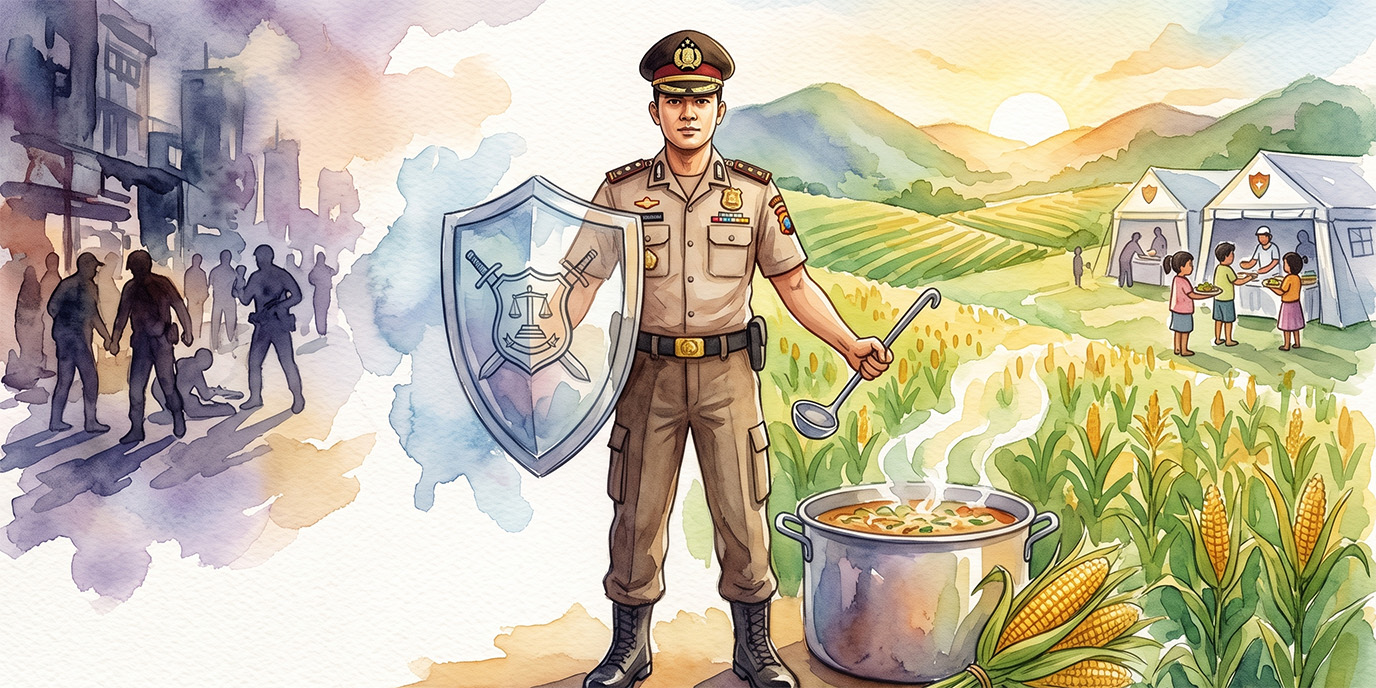
 Generated by AI


Penulis

This year’s Bhayangkara commemoration marked an important moment for the National Police (Kepolisian Republik Indonesia, Polri), as it coincided with the revision of the National Police Law through Law No. 5/2026. The new law includes some improvements, especially in recognising professionalism, proportionality, transparency, and accountability as policing principles. It also strengthens oversight tools and requires human rights, democratic values, and a humanist approach to be included in police professional education. A similar emphasis appeared in National Police Chief Gen. Listyo Sigit Prabowo’s speech at the Bhayangkara ceremony. He linked police transformation to this year’s theme, “Polri for society,” presenting it as a commitment to keep the institution present and responsive to citizens’ needs.
The more contentious point, however, was the police chief’s emphasis on the police’s role in running kitchens (Satuan Pelayanan Pemenuhan Gizi, SPPG) for the free nutritious meals programme (Makan Bergizi Gratis, MBG) and supporting corn harvests for food security (Mumpuni, 2026). President Prabowo Subianto even praised the police’s SPPG as among the best in delivering the MBG programme. This raises the public question of whether such activities belong within police work at all, especially as Polri is increasingly drawn into development tasks and civilian bureaucratic roles. That question is the entry point for examining the police’s expanding mandate, the risks it creates, and how those risks can be managed.
The answer begins with a harder reality: the expansion of police work has been backed by a political and legal basis. Politically, Prabowo does not treat the involvement of the Indonesian Military (Tentara Nasional Indonesia, TNI) and Polri in socio-economic programmes as a deviation from their mandate. He has acknowledged that “only in Indonesia do the police handle agriculture” and that “perhaps only in Indonesia are soldiers often in the fields,” but treated such involvement as part of the state’s response to strategic public needs (Trikarinaputri, 2026). This was not a new view. In earlier statements, Prabowo had already defended police involvement in food-related work by arguing that Indonesia’s conditions require all institutions to work together (Anggrainy, 2025; Faradianti, 2026). His later call for the public not to question TNI-Polri involvement further shows how this model is being normalised (Chaterine, 2026).
On the legal side, the revised Police Law gives this expansion a firmer footing. Here the law shows a Janus-faced character. On one side, it strengthens oversight tools and requires human rights, democratic values, and a humanist approach in police professional education. On the other hand, another face of the law appears in Article 14(1)(m) on additional police duties tied to presidential policy, and in Article 28A on the placement of active police officers in civilian bureaucratic posts. These provisions create two channels of expansion: one through operational assistance, the other through police placement inside the civilian bureaucracy. The MBG programme offers one example. Police involvement in the programme can be linked to the assistance clause, while the civil-position clause allows active police officers to occupy posts in civilian agencies such as the National Nutrition Agency (Badan Gizi Nasional, BGN). Previously, by contrast, such non-core roles had no explicit basis in the Police Law and usually relied on Memorandums of Understanding (MoUs) or stretched interpretations of active-officer placements in civilian posts.
The Costs of an Expanding Mandate
The police’s expanding role deserves serious caution. First, it risks stretching Polri beyond its institutional capacity by diverting its organisational attention and personnel. At the organisational level, the police’s strategic planning has increasingly mirrored the government’s economic priorities. The shift took place during the second term of Joko Widodo’s (Jokowi) administration, after a first term still largely aligned with the police’s institutional mandate. Since Prabowo took office, this pattern has become even more explicit through the socio-economic agenda. This year, the police’s planning is framed around supporting food and energy sovereignty, as well as a productive and inclusive economy. For 2027, the plan continues in the same direction, supporting the acceleration of quality growth through productivity, investment, and industry (Sutrisna and Akbar, 2026).
The placement of active officers in civilian posts is also part of the problem. Beyond weakening police professionalism, it opens wider space for conflicts of interest. The revised law creates a workaround by using the language of connection to police functions and allowing placements through institutional requests or presidential assignments under Article 28A(3). As a result, active officers may still enter agencies with little connection to policing, further pulling personnel away from their core competencies.
Whether Polri can effectively carry out work outside its core mandate remains questionable, given the mismatch between such assignments and the police’s training and experience. While Polri’s report (2025) and the police chief’s speech framed the programme as a major success, the success narrative is not without problems. Tempo showed how Polri used various tactics to project achievement in the corn programme, while irregularities remained behind the claimed results (Rosana, 2026).
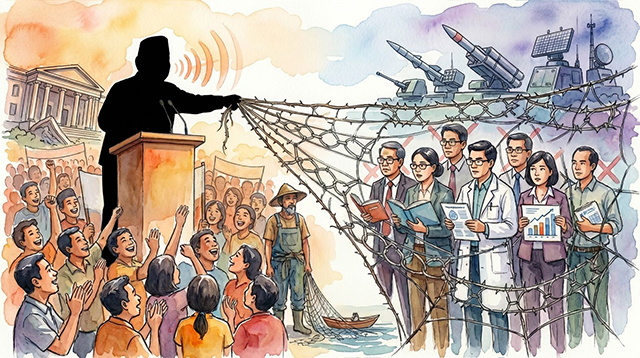
Second, it sharpens public concern over the politicisation of the police, especially in the residue of the 2024 election. The concern is therefore not exaggerated, since politicised policing fits within Indonesia’s broader authoritarian revival under Jokowi (Jaffrey and Warburton, 2025). Polri is a particularly effective instrument of that revival because, unlike the military, it operates domestically and holds the investigative and public-order powers that can be turned on political rivals and civil society alike. Under Prabowo, the same pattern appears to be continuing, as security institutions are drawn into presidential priorities. Presidential policy is a broad category, and it may include politically expedient programmes that serve the president’s political interests more than the public interest.
There may also be a reciprocal effect. Polri may help deliver the president’s agenda, but such support can also generate institutional returns for Polri and deepen the loop of politicisation. One early opening lies in Article 30(5)(c), which allows the retirement age of four-star police generals, a rank generally held by the National Police chief, to be extended according to needs determined by presidential decision.
A Way Forward: Limits and Reforms
Taken together, these risks point to four necessary responses that the government and the police must take. First, the government must limit the assistance clause tied to presidential policy by establishing clear operational rules. Although Police Law No. 5/2026 does not explicitly mandate it, the government should issue an implementing regulation to ensure police involvement outside Polri’s core functions remains temporary and well-defined. To guarantee compliance, the National Police Commission (Komisi Kepolisian Nasional, Kompolnas) and the House of Representatives (Dewan Perwakilan Rakyat, DPR) oversight commission should actively oversee its enforcement. In normal circumstances, police involvement must be confined to matters within the institution’s mandate, such as mitigating public-order risks or addressing criminal offenses arising from the implementation of programmes.
Second, the government must empower civilian institutions to ensure they remain the primary actors responsible for welfare and development. Achieving this requires the Prabowo administration to firmly resist the temptation of using Polri or the TNI as shortcuts. The institutional architecture for development already exists: ministries, agencies, and local governments possess the necessary sectoral mandates, technical expertise, budgetary authority, and mechanisms for public accountability. Instead of making the police an executor of development programmes, the appropriate policy response is to build upon these civilian frameworks.
Third, Polri needs real cultural reform to prevent its expanding role from simply reproducing old problems. The Police Reform Acceleration Commission (Komisi Percepatan Reformasi Polri, KPRP) identified nine negative cultural patterns: violence, militaristic conduct, corruption, patronage, the blue code of silence, excessive esprit de corps, impunity, noble-cause corruption, and goal displacement (KPRP, 2026, p. 38). Cultural reform has become even more urgent with the alleged corruption case in the MBG programme involving Lalu Muhammad Iwan, an active senior police officer, and Sony Sonjaya, a retired two-star police general, both serving at the BGN. That case should be treated as a warning. Reform therefore has to intervene where police culture is actually formed, from recruitment and police education to promotion, command practice, and daily field supervision.
Fourth, Polri must refocus on its core duties: law enforcement and public security. These are the areas where the public most clearly expects Polri to deliver protection and justice. This means using the KPRP’s diagnosis as a concrete reform agenda for law enforcement and investigation (KPRP, 2026, pp. 76-77). At the everyday level, the police need to address problems most directly felt by the public, including undue delays, weak case-update transparency, informal costs, and limited accountability over investigators. These improvements must be matched by stronger due-process safeguards against abuses such as violence and fabricated cases, as well as firmer controls over conflicts of interest and transactional handling in business and political cases. The attack on KontraS activist Andrie Yunus was precisely the kind of case where Polri needed to show institutional resolve. Given the long-standing questions about actors beyond the four soldiers tried before the military court, Polri should have moved the case forward, especially after a pretrial ruling required it to continue the investigation.
Public safety and security also need more serious attention. Polri must improve its ability to address problems that visibly disturb public order, including violent street crime (begal) and organised criminal groups (preman). Police operations should not mistake low-level actors for the real target; they must reach the organisers and protectors behind the crime. The same discipline must apply to narcotics and online gambling, where enforcement often stops at users or small players while larger networks remain intact. Domestic security problems will not be solved through repression or over-criminalisation, much less through military assistance.
Conclusion
The real test of police transformation will lie in implementation. Under Prabowo’s presidency, however, Polri is likely to be drawn further into presidential socio-economic programmes, increasing the risk of overstretch and politicisation. Four tasks therefore require serious attention: limiting police assistance in presidential programmes, strengthening civilian institutions rather than bypassing them, turning cultural reform into daily institutional practice, and refocusing Polri on law enforcement and public security. Only then can “Polri for society,” as invoked by Gen. Listyo Sigit Prabowo, become more than an institutional slogan.
References
Anggrainy, Firda Cynthia. 2025. “Prabowo: Eropa Bingung Polri Urus Jagung, Ini Indonesia Bung!” detikNews, October 29. https://news.detik.com/berita/d-8184139/prabowo-eropa-bingung-polri-urus-jagung-ini-indonesia-bung
Chaterine, Rahel Narda. 2026. “Prabowo Minta TNI-Polri Turun ke Sawah Tidak Dipersoalkan.” Kompas.com, July 17. https://nasional.kompas.com/read/2026/07/17/20104641/prabowo-minta-tni-polri-turun-ke-sawah-tidak-dipersoalkan
Faradianti, Merinda. 2026. “Prabowo Soal TNI-Polri Urus Jagung: Mereka Berpihak ke Rakyat.” Bloomberg Technoz, May 16. https://www.bloombergtechnoz.com/detail-news/109116/prabowo-soal-tni-polri-urus-jagung-mereka-berpihak-ke-rakyat
Jaffrey, Sana, and Eve Warburton. 2025. “Introduction: Jokowi’s decade in power.” In The Jokowi Presidency: Indonesia’s Decade of Authoritarian Revival, edited by Sana Jaffrey and Eve Warburton. Singapore: ISEAS Publishing.
Komisi Percepatan Reformasi Polri. 2026. Laporan Komisi Percepatan Reformasi Polri (KPRP) kepada Presiden Republik Indonesia. https://s.setneg.go.id/komisipercepatanreformasipolri
Markas Besar Kepolisian Negara Republik Indonesia. 2025. Capaian Gugus Tugas Ketahanan Pangan, GPM, MBG Polri & SMA KTB. Oct 21. https://eppid.polri.go.id/api/ppid-data-files/viewer/RELEASECAPAIANGUGUSTUGASPOLRI_compressed_5905.pdf
Mumpuni, Ayu. 2026. “HUT Bhayangkara ke-80: Kapolri Pamer MBG Polisi Zero Accident.” Tirto, July 1. https://tirto.id/hut-bhayangkara-ke-80-kapolri-pamer-mbg-polisi-zero-accident-hy1i
Rosana, Fransisca Christy. 2026. “Siasat Polisi Terlihat Berhasil Menanam Jagung”. Tempo, March 22. https://www.tempo.co/politik/polisi-tanam-jagung-ketahanan-pangan-2123592
Sutrisna, Tria, and Nawir Arsyad Akbar. 2026. “6 Prioritas Polri pada 2027: Meningkatkan Kualitas Pelayanan Publik.” Kompas.com, June 17. https://nasional.kompas.com/read/2026/06/17/13535621/6-prioritas-polri-pada-2027-meningkatkan-kualitas-pelayanan-publik
Trikarinaputri, Ervana. 2026. ”Prabowo: Hanya di Indonesia Tentara -Polisi Urus Pertanian.” Tempo, June 24. https://www.tempo.co/politik/prabowo-hanya-di-indonesia-tentara-polisi-urus-pertanian-2271322