



 A Closer Look at Indonesia’s Judicial Review Cases


Penulis

More than two decades have transpired since the establishment of Indonesia’s Constitutional Court in 2003. Over the relatively long period of time that the Court has been in existence, the number of cases has traditionally fluctuated from one year to another. This assumption remains true, specifically in cases relating to the Court’s law review power. In that context, the trajectory of these numbers has never been a single, progressing arrow, where the sum of registered cases in the succeeding year is always greater than the preceding year, or vice versa. In 2016, for instance, the number of registered law review cases was fewer than in 2015 (Mahkamah Konstitusi RI, 2025a). On the other hand, in 2023, the Court witnessed an increase in the number of registered cases compared to 2022 (Mahkamah Konstitusi RI, 2025a).
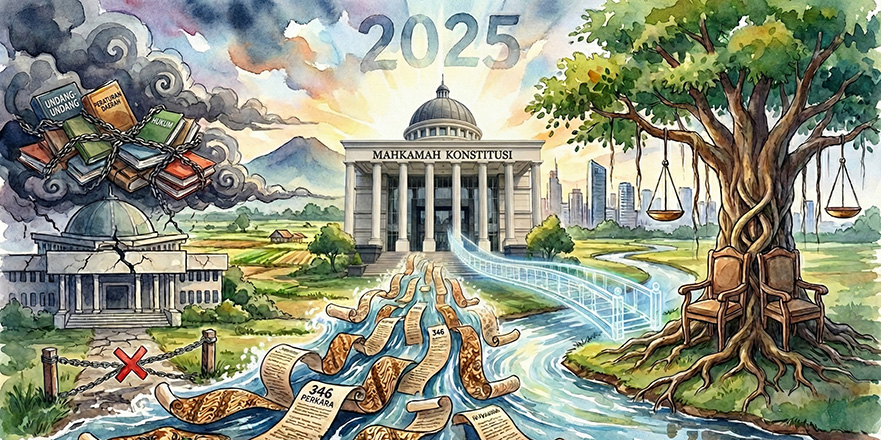
With no definite pattern to assume, the year 2025 is a particularly curious year to observe. It has been the busiest year in the history of the Court. As of 19 December 2025, the Court has registered a total of 346 law review cases, with 263 judgments having been rendered (Mahkamah Konstitusi RI, 2025a). A sum totaling greater than both the cases registered and judgments issued in the years 2022 and 2023, combined (Mahkamah Konstitusi RI, 2025a).
Magnifying this figure, is there any lesson that can be derived from the astronomical number of law review cases registered in 2025?
An Exercise of Public Scrutiny
As an attempt to begin such an investigation, a revisit to the philosophical plinth on which Indonesia’s judicial review rests is essential. In this vein, judicial review is not an automatic mechanism. It is not an avenue where the judiciary, unilaterally and unprovokedly, extends its tentacle of power to determine the validity of an Undang-Undang (law), which is a product that is mutually agreed upon by the Executive and the Legislative branches.
Rather, a judicial review materializes only when there is a petition brought by those who feel that their rights have been harmed by a certain law. To be operational, a judicial review, therefore, requires a trigger. Such a trigger often takes shape in the form of a sense of dissatisfaction coupled with tangible constitutional harm, from an individual, or, to put it in a larger horizon, from the public. Equipped with this understanding, a judicial review can be interpreted as a form of balancing power, an exercise of scrutiny to correct the law, initiated by the public who are subjected to said law, and administered by the judiciary.
Diagnosing the Symptoms
Against this backdrop, the initial question can consequently be modified with more precision: what makes 2025 a particularly stimulating year for the public to exercise their rights to correct the law? Adjacent to this question is a starker point to contemplate: what causes the public to believe that they, by and large, have been constitutionally harmed throughout 2025?
By drawing upon some of the judicial review cases, at least two possible explanations can be offered to illuminate these guiding questions, namely, the unsatisfactory legislative practice and the Executive’s contentious application of the law.
First, the legislative process through which several laws were formulated in 2025 did not meet some of the public’s expectations. To this end, beyond the substantive quality of the provisions within the law, what is equally important is the procedure by which a draft law crystallizes into a binding instrument, or the lawmaking process itself.
Granted, out of all the registered law review cases before the Constitutional Court in 2025, not all of them pertain to the laws that were legislated in 2025. Nonetheless, several immediate challenges against laws that were passed in 2025 indicate a degree of dissatisfaction on the petitioners’ end with the way some laws were formulated throughout that year. These include formal judicial reviews of Law No. 1 of 2025 on the Third Amendment to Law No. 19 of 2003 on State-Owned Enterprises (BUMN Law), and Law No. 3 of 2025 on the Amendment to Law No. 34 of 2004 on the Indonesian National Army (Army Law).
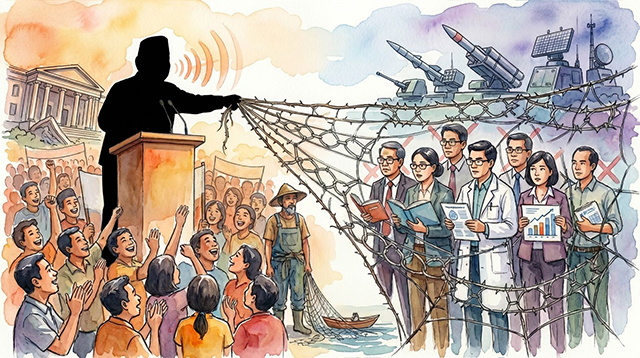
While these formal judicial review petitions were eventually rejected by the Court, in Case No. 81/PUU-XXIII/2025, Justice Suhartoyo’s dissent shed light on the technical elements that characterize some flaws within the existing lawmaking process. In this regard, Suhartoyo criticizes the approach that both the Executive and the Legislative took in strategically limiting the dissemination of relevant documents relating to the draft law from general public access (Mahkamah Konstitusi RI, 2025b).
Additionally, Suhartoyo also highlights the importance of lawmakers to facilitate a sufficient momentum for the public to give feedback on the draft law (Mahkamah Konstitusi RI, 2025b). In arriving at such a conclusion, Suhartoyo considers that a supposed public forum, which was held only two days prior to the Army Law being passed, ignored such a temporal threshold to capture meaningful public participation (Mahkamah Konstitusi RI, 2025b). The same tone to stress the necessity of a momentum for the public to give inputs is also shared by Justice Enny Nurbaningsih in her dissent in Case No. 64/PUU-XXIII/2025 on BUMN Law (Mahkamah Konstitusi RI, 2025c).
From another angle, Justice Saldi Isra, in his dissent in Case No. 81/PUU-XXIII/2025, specifies the strict nature of planning in the lawmaking process. In assessing the legitimacy of the lawmaking procedure, Isra argues that mere political consensus between the Executive and the Legislative to proceed in formulating a certain law cannot be used to circumvent the necessity to adhere to the strict procedure within the lawmaking process (Mahkamah Konstitusi RI, 2025b).
Second, some of the Executive’s application of existing laws did not align with certain values that the public had hoped to preserve. In applying existing laws, the Executive, from time to time, exercises a legal interpretative endeavor to justify its practices. Such an exercise, if done too expansively, may collide with norms that the public seeks to preserve, including good governance principles.
To this end, Case No. 114/PUU-XXIII/2025 provides a clear tension between what the Executive considered to be a legitimate practice according to the law and the practice that the public hoped the Executive would’ve otherwise exercised. On this matter, the appointment of active police officers to occupy positions in institutions outside of the National Police was the trigger that drove the petitioners to challenge Law Number 2 of 2002 on the National Police (Police Law) (Mahkamah Konstitusi RI, 2025d). In the petition, the petitioners argue that such a practice, which stems from the ambiguity of the Police Law, fertilizes the potential conflict of interest, disrupts the police’s neutrality, and may translate into a form of abuse of power (Mahkamah Konstitusi RI, 2025d).
In granting the petition, the Court, in its judgment, deems that the only way for an active police officer to assume another position outside of the National Police is either to first resign or retire (Mahkamah Konstitusi RI, 2025d). In the same spirit, the Court also implies that by allowing the dual position practices by active police officers to fester, legal uncertainty for the career of civil servants outside of the National Police may accumulate (Mahkamah Konstitusi RI, 2025d).
Comparably, in Case 128/PUU-XXIII/2025, the petitioners were motivated by the Executive’s practice of encouraging vice ministers’ dual positions, by allowing them to concurrently assume the role of commissioners in State-owned Enterprises (Mahkamah Konstitusi RI, 2025e). The petitioners argue that such a practice is irreconcilable to the “constitutional morality”, for it transgresses the principles of accountability, transparency, and public service (Mahkamah Konstitusi RI, 2025e).
Having weighed the petitioners’ argument, the Court emphasizes that the prohibition of dual position extends to the vice minister position, as such a prohibition resonates with the clean State administration principle, hinders potential conflict of interest, and promotes good governance.
Moving Forward
Beyond the discussions above, it is an approximate certainty that more explanations can be extracted from the 2025 judicial review cases. On that note, a wider array of prescriptions, therefore, may also be offered. However, given the two symptoms that this essay is orbiting its analysis upon, one remedy is suitable to be prescribed to. That remedy is the incorporation of public involvement, be it in lawmaking or governing processes.
As cliché as it may sound, public involvement rests at the soul of a democratic State. It is in the best interest of the lawmakers to proactively seek public participation and to continuously innovate on better ways to obtain it. Similarly, the Executive’s way to govern must also heed the public’s aspiration for good governance. It should continuously strive to be a fine institution that transcends beyond the mere application of a strict letter of the law, but is also guided by the unrelenting conviction to emulate virtue and nobility, ones that correspond with the public’s hope (Mahkamah Konstitusi RI, 2025e).
As a final note, this writing is not oblivious to the fact that both contradiction and convergence between various interests are incumbent in both lawmaking and governing processes. Naturally, the temptation to either accelerate the formulation of the law or to employ a greater room for discretion in governing sometimes dwarfs the interest in meaningfully accommodating public involvement. Contemplating what has transpired in the year 2025, such a temptation must be tempered down. By the end of the day, judicial review is a reactionary pulse from the public, one that echoes Newton’s third law of motion. To preempt it, high-quality public involvement is key, for it is one way to avert public dissatisfaction from transforming into a legal petition.
Referensi:
Mahkamah Konstitusi RI. (2025). Rekapitulasi Perkara Pengujian Undang-Undang accessed on 19 December 2025. https://www.mkri.id/perkara/rekapitulasi-perkara/puu
Mahkamah Konstitusi RI. Judgment Number 64/PUU-XXIII/2025.
Mahkamah Konstitusi RI. Judgment Number 81/PUU-XXIII/2025.
Mahkamah Konstitusi RI. Judgment Number 114/PUU-XXIII/2025.
Mahkamah Konstitusi RI. Judgment Number 128/PUU-XXIII/2025.