



 Indonesia Cannot Afford Its Own Lost Generation


Penulis

Trapped in the Precariat Class
In 1929, Ernest Hemingway published a novel titled The Sun Also Rises, which depicts the psyche of the so-called “lost generation”, a cohort who entered young adulthood during and after World War I. This is a generation that, due to war trauma, is mentally, emotionally, and morally lost. The recent wave of youth uprising in cities such as Kathmandu, Paris, Manila, and Antananarivo is not a mere outburst of emotion. It reflects deep-rooted frustration towards corrupt politics, widening economic inequality, and the state’s failure to guarantee a dignified life for the young people. Moreover, it is a collective agency of the young people asserting and reclaiming their rights to a better future.
Indonesia is at risk of having its “lost generation” not because of war trauma, but the scarcity of quality jobs. In 2024, Ministry of Manpower data shows that around 10 million (21,4 percent) of the 44,33 million youth aged 15–24 were not in education, employment, or training (NEET). It is about 5 percent higher than the average of upper-middle-income countries and 10 percent higher than neighbouring countries like Malaysia, Singapore, and Thailand.
Even those who are employed do not necessarily earn enough to pursue self-actualization or plan for the future. As of February 2025, Statistics Indonesia (BPS) reports that the average net monthly wage for employees aged 15–19 was about Rp1,92 million, while those aged 20–24 earned around Rp2,41 million. So, using simple average method, the monthly earnings of Indonesia’s young people aged 15-24 are Rp2.16 million, which is lower than the minimum wage in the district with the lowest minimum wage (UMR) in Indonesia, Banjarnegara, at Rp2,17 million. Job insecurity, low pay, and thin social protection are pushing young Indonesians into precarious living conditions.
The Risks of Precaritization
In The Precariat: The New Dangerous Class, Guy Standing describes the psychosocial condition of the precariat through the Four A’s: Anger, Anomie, Anxiety, and Alienation. The collapse of hope for upward mobility breeds anger that morphs into despair, loss of direction, and a persistent fear of failure. This culminates in social alienation. People withdraw from their communities and the world around them.
Anne Case and Angus Deaton, in Deaths of Despair and the Future of Capitalism, show the extreme consequences of the loss of dignified work: despair that can lead to suicide. The danger of unemployment underlines that work is more than material benefits. It corrodes human connection, life’s purpose, then breeds hopelessness. As Emile Durkheim would argue, a quality job provides a framework for a meaningful and dignified life.
In today’s digital and social-media age, where everyone can constantly compare their lives to others, this constant comparison can magnify envy and the feeling of inadequacy. There is a widening gap between the imagined ideal life on social feeds and the stubborn reality of everyday existence.
From Amartya Sen’s perspective, the absence of decent work represents a deprivation of capabilities to achieve valuable functionings to pursue the life one has reason to value. In this sense, Indonesia’s young people are losing the freedom to choose a good life. Left unaddressed, this will become a time bomb that could explode into larger problems for Indonesia.
At the societal level, ‘precarization’ tends to widen inequality. As Anthony B. Atkinson stresses in Inequality: What Can Be Done? inequality restricts access to resources that enable social mobility, such as quality education, healthcare, and social networks. Those at the bottom are trapped, particularly in this era of economic financialization, where hard work is beaten by financial accumulation. Like quicksand, they are pulled further down with little ability to resist.
Politically, a society marked by anger, anxiety, and exclusion loses trust in the society and the state. The result is apathy, even antipathy, toward politics. Rising inequality aggravates this condition. A distrustful public is easily provoked and swept up by divisive populist narratives. If this continues, Indonesia’s pluralist values, the bedrock of our politics and democracy, will erode, and power will grow more elitist.
Leadership by Example and Commitment
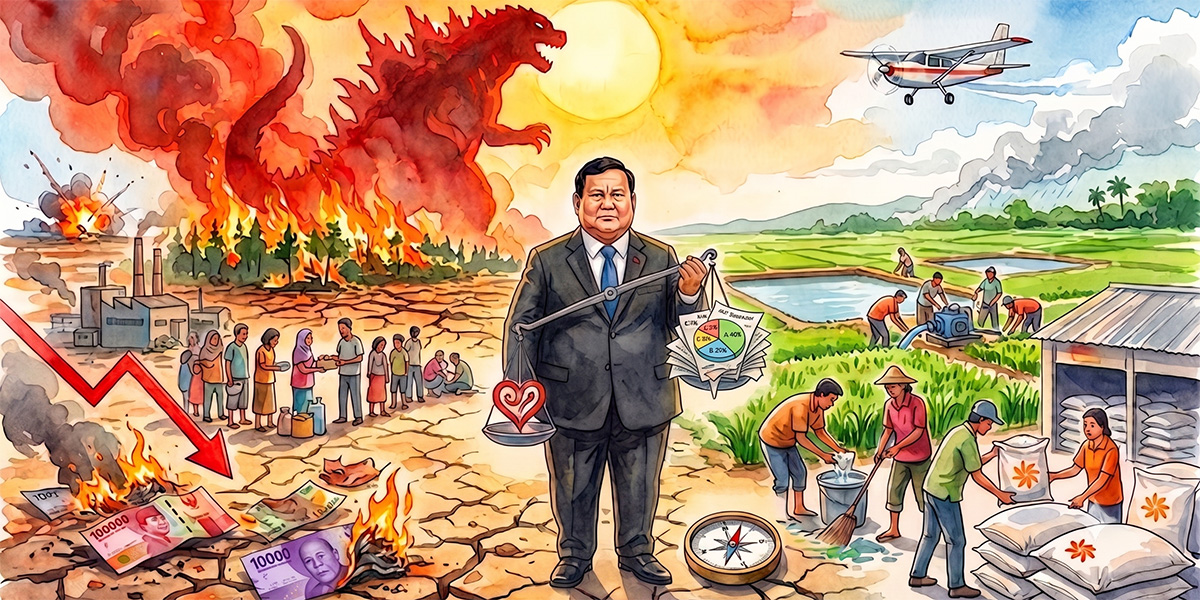
There is nothing truly new under the sun, including policies Indonesia needs. We already know the solution for Indonesia’s employment situation lies in reindustrialization, which can create more quality jobs and expand the social safety net. President Prabowo has, in principle, placed reindustrialization among his top policy priorities. The National Medium-Term Development Plan (RPJMN) envisions industrialization that is integrated into global supply chains and generates high value-added.
What matters now is institutional capability. A competent, rules-based bureaucracy and steady, well-signaled policy are the only credible path to restore confidence. The President’s flagship programs can deliver real multiplier effects for growth and jobs, but the execution remains the main challenge. Without transparent processes, measurable outcomes, and agencies that can deliver on time and on budget, trust will be hard to rebuild. Nothing erodes confidence faster than visible incompetence. If the government fails to provide dignified work and credible protection, Indonesia risks producing its own “lost generation,” not in cafes and war memories like the characters in Hemingway’s story, but in job queues and unfulfilled dreams.